Building Character - or Building Barriers?
Council debate and voting are often confusing - especially if you are unfamiliar with the interaction of LEP, DCP, HCA and PPs in DPHI. That's a shame, because these decisions directly affect us, usually hitting our hip pocket.
Last night's discussion about finalising the Berry Heritage Review made it abundantly clear that the township of Berry is somehow special, again. One person willing to scrutinise and criticise Berry's Heritage Review and development control amendments is Kate Dezarnaulds. "Willing" because her position on town planning is not universally admired, and social media debate is brutal.
But Dezarnaulds' insight into Berry is a prime example of how the machinations behind local government decisions on our towns' future happen long before Councillors vote, and are often shrouded from public view.
Heritage, Character and the Politics of Language
by Kate Dezarnaulds
Planning debates seem to land very differently depending on where you live on the South Coast.
In Callala and Culburra, “character” is about protecting bushland and floodplains from speculative coastal estates dressed up as solutions to the housing crisis.
In Kiama, “character” is something the State Government is steamrolling in pursuit of long-missed housing targets — overriding years of local consultation and imposing scale and heights that offend locals and create a burden the infrastructure cannot carry.
In Berry, “character” just became something else altogether.
What happened last night in the February Shoalhaven Council meeting makes the word “character” worthy of much closer attention in the realm of town planning.
Same Word. Different Stakes.
“Character” sounds universally virtuous, but it is a nebulous concept. A vibe.
It evokes care. It signals pride. It suggests continuity and restraint.
Who doesn’t want to protect character?
But it turns out, what precisely is protected depends entirely on murky local politics, village-level context and who had edit access to the final draft.
For example, in Callala and Culburra
In Culburra's community, an absence of architectural heritage makes character shorthand for ecological defence. Manyana's sense of place is similar
For locals in Callala, protecting character speaks to an understanding that mature forest does not regenerate once cleared. Nest hollows can’t be relocated. Gliders can't 'fly away' from home.
Coastal character means flood-prone land that should never have been rezoned to carry dense housing and Aboriginal lands already carrying thousands of years of sacred history.
Character means resisting speculative Airbnb estates disingenuously promoted as a solution to the much-needed housing supply.
In that context, defending character is defending landscape integrity and environmental safety - in my book, a very real fight.
Meanwhile, in Kiama
In Kiama, “character” was painstakingly articulated through years of community consultation — scale, rhythm, coastal village proportions — only to be overridden by a state Government desperately short on its own housing targets.
After weighing up the balance between character, heritage and future need, the community reluctantly agreed to two storeys becoming four. Four sometimes became six. And then, completely sidelined, six to eight storeys and beyond are being imposed with minimal local input.
There, defending character is about proportionality and ensuring infrastructure capacity keeps up with demand. It is about not overwhelming sewerage systems, forgetting parking or crippling small business precincts overnight.
Again, I reckon that one’s a real fight.
But, in Berry
When it comes to Berry politics, it seems Berry is the exception to the rule.
You see, Berry already has extensive heritage listings, two-storey height limits, density controls, strict zoning, established conservation areas and minimal remaining lots zoned R3 for townhouse development
Berry is not facing a risk of high-rise imposition. Berry is not facing widespread bushland clearance. Berry can never become the oft-cited and apparently dreaded … Shell Cove.
Yet in Berry, “character” has now been embedded into a new Development Control Plan (DCP) that guides/demands aesthetic compliance across non-heritage sites in the entire village of “Old Berry”.
Most Berry residents have no idea what constraints on their property were approved by Council in the name of protecting the town's character and preventing the much-feared spectre of overdevelopment.
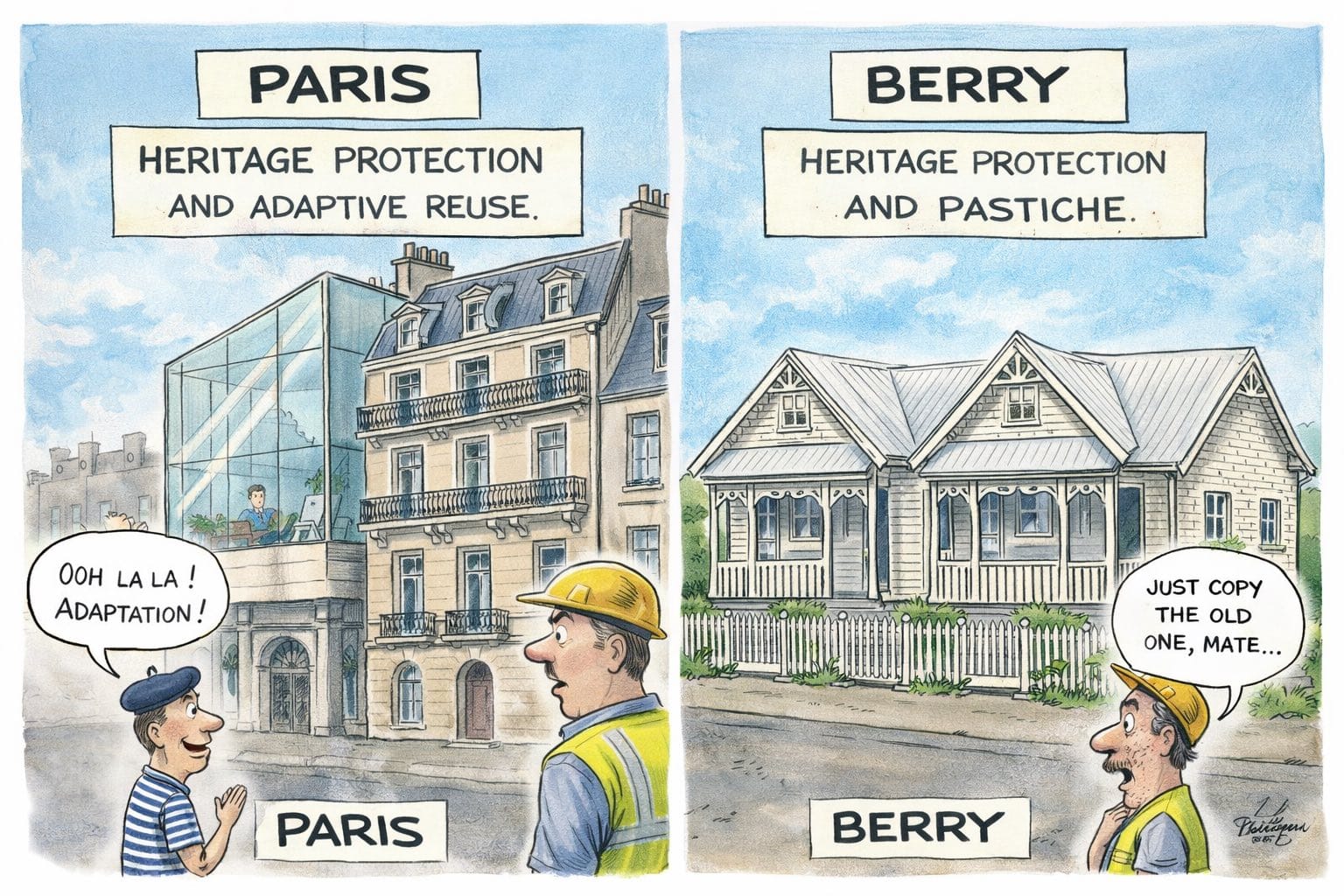
Berry's new DCP makes sure that “character” increasingly defends a pastiche of familiarity - a preferred aesthetic set in the white picket fence era of the 1940’s and 50’s. It defends status quo advantage and specifies what Berry should look like in the imagination of a narrow group that helpfully offered to draft this DCP on behalf of the community. It is based on outdated heritage ideals as a Trojan horse strategy for objecting to the development of the Berry Hotel.
Because character was so successfully framed as being pro-heritage and anti-overdevelopment, questioning it became politically radioactive. Just check the Community Facebook page for a sense of what’s at stake if you dare to question the details of the orthodoxy.
Heritage vs Character — The Slippery Shift
As a former Board Director of the National Trust of NSW, I probably know more about contemporary approaches to heritage management than most.
I love Heritage. I'm a huge fan.
Heritage is factual. Preserving it is expensive and restrictive, but identifying it is clear. It is statutory. It is evidence-based. It is mapped. It protects places of established significance. It is proportionate to significance. It is encouraged to be adaptive. It loves living alongside contemporary architecture and is enlivened by regular use.
While Character is elusive, elastic. Its prominence in development language is emerging. It changes its spots regularly to suit the status quo and is invoked by both sides of politics on occasion to suit varying and competing agendas. Character can describe context. Or it can prescribe aesthetics. At its best, it can guide. At its worst, it is deployed to police individual taste and budget.
That shape-shifting matters because Shoalhaven Council just finalised a Development Control Plan for Berry that embeds “Desired Future Character” well beyond protecting mapped heritage to operate as a de facto new development standard.
This is where a big governance risk begins for Council, and a whole world of cost, delay and inconvenience begins for the good people of Berry.
 Andrew Taylor
The Backstory: LEP Character Was Blocked
What madness brewed this confusing storm in a Berry teacup?
Late in 2024 and early in Mayor Patricia White's tenure, leading a dominant Shoalhaven Independents Group of councillors, Council staff proposed embedding character provisions in the Shoalhaven Local Environmental Plan (LEP) 2014. through the Planning Proposal 073 (PP073).
An LEP is a statutory instrument. If character were to have coherent legal force, that is where it belonged.
Community campaigning across the Shoalhaven for a variety of reasons from both sides of the political spectrum saw wide support for the inclusion of Character in the LEP and the PP073 was voted through with SIG, Independent and Labor support.
But that decision was quickly and mysteriously rescinded by the SIG bloc who had initially supported it. Attempts by the minority Labor and Independent councillors to reinstate the original decision failed.
Public fear and acrimony suggested that development industry opinion pressured councillors.
Ultimately, SIG and its industry advisors ensured Shoalhaven rejected systemic, region-wide character reform at the LEP level, despite communities demanding it.
So, why is the Shoalhaven Independents Group comfortable with patchwork, hyper-local character controls for Berry, but opposed to coherent statutory ones everywhere else?

Berry Exceptionalism Explained
Berry's campaign was hard to refuse for a few reasons:
It was hyper-local. It was exceptionally organised. It was tied to a flashpoint development — the Berry Hotel. And it arrived, helpfully, with a near-complete draft, endorsed by the influential Berry Forum, which presented ample political risk for any councillors who dared oppose.
Normally, Development Control Plans (DCPs) are authored by Council planners. But not in this case. The Berry Forum Community Consultative Body drafted and endorsed a framework.
Council warned against wasting precious resources, but that advice was overruled by Councillors, who approved further consultations with the wider community via consultants, Locale.
Despite many submissions raising concerns about overreach and the governance risk should Berry's DCP be approved ahead of the LEP, the final document returned looking remarkably similar to the original Berry Forum framework and the DCP component was waved through Council yesterday without question, clarification or challenge.
The Political Contradiction
So here is the uncomfortable and confusing part. Councillors who resisted embedding character in Shoalhaven's LEP - claiming it would hobble housing supply and not serve the needs of communities - enabled Berry's character statement in this DCP.
SIG councillors opposed character provisions elsewhere in Shoalhaven where development interests are active. Yet in Berry, where opposing the DCP would have been politically costly, the document passed.
Labor Clr Matt Norris and independent Clr Jemma Tribe did ask intelligent questions about homeowner impact and legal exposure - but only in relation to properties affected by new heritage listings – not the wider non-heritage properties affected.
Despite comprehending the risks to Council and community from likely and expensive legal challenges, and anticipating conflicts between the DCP and LEP, most councillors voted in favour anyway.
Why? Because voting against “character protection” in Berry would be unpopular in the rest of the Shoalhaven.
Wading into planning debates in small towns is not for the faint-hearted.
It’s not long before people are behind their parapets hurling accusations — “developer-mates,” anti-heritage, NIMBY, YIMBY, protectionist, divisive.
Words like heritage and character carry enormous emotional weight. People love where they live. They fear change. They want to protect their primary asset. They like their view, the familiarity. Yes, there is a housing shortage and spiralling costs — but surely that should be solved somewhere else. Somewhere without so much “character.”
Character statements are pursued by progressives to limit developer overreach in less-protected areas. Meanwhile, character limitations appeal to conservatives like SIG councillors and their Berry supporters, even though it makes development more difficult.
That's Character. Same word but in a different postcode, it has a different impact.
That may be convenient politics. But it certainly is not coherent planning.
What's the Practical Outcome?
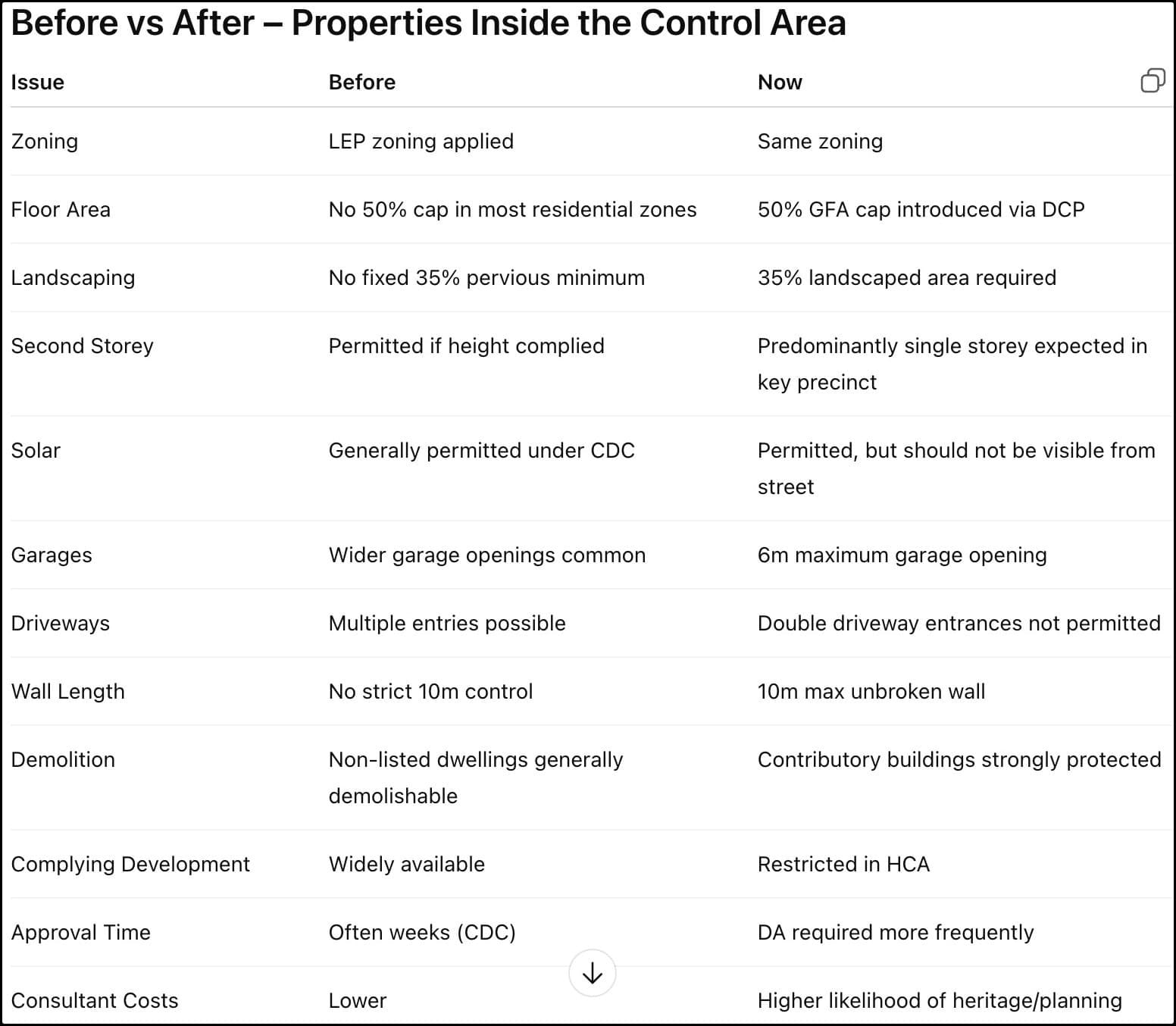
The newly approved Berry DCP cannot legally override the current LEP provisions in Berry. But to renovate your home in Berry, you may have to get a full DA, pay the costs of expert heritage reports, and navigate coordinated campaigns from objectors, potentially all the way to Land & Environment Court.
Berry's DCP is unusual in that it is highly prescriptive, with mandatory roof pitches, major constraints on contemporary materials use, new envelope projections that effectively reduce LEP height, and a universal “character compliance” which blurs into being some kind of shadow regulation.
What will now happen is that complying pathways shrink, modest projects will require full DAs, assessment complexity increases for Council, building costs rise, timelines will stretch, local objection grows, and legal appeals become more likely.
Large, wealthy developers can absorb that, but ordinary homeowners and small businesses cannot. The ultimate irony? The controversial Berry Hotel Development Application that triggered this whole debate will not even be assessed under this DCP.
I have seen firsthand how thoughtful design can enhance a streetscape without resorting to pastiche, and how rigid, overly prescriptive controls can unnecessarily increase costs, delay projects, and deter sensible improvements to non-heritage properties.
As a builder's wife, an architect's daughter and an owner of a non-heritage brick home within the specified area, I understand both the importance of protecting genuine heritage significance and the practical realities of building, renovating and adapting homes and commercial spaces to meet contemporary needs.
As a local business owner, I can attest to the difficulty of securing suitable commercial space in Berry. Restrictive built-form controls risk further constraining adaptability in the CBD, increasing rents and limiting economic vitality.
I tried to warn our Councillors that if a DCP is in conflict with the LEP, it invites challenge. And we all know that even unsuccessful Land & Environment Court appeals cost ratepayers BIG money.
But, political cowardice in Berry overrode fiscal caution for the region.
Berry: where the only constant is change
Berry has evolved from its dairy farming roots, but, ironically, many of the towns' most recent arrivals are those most resistant to change.
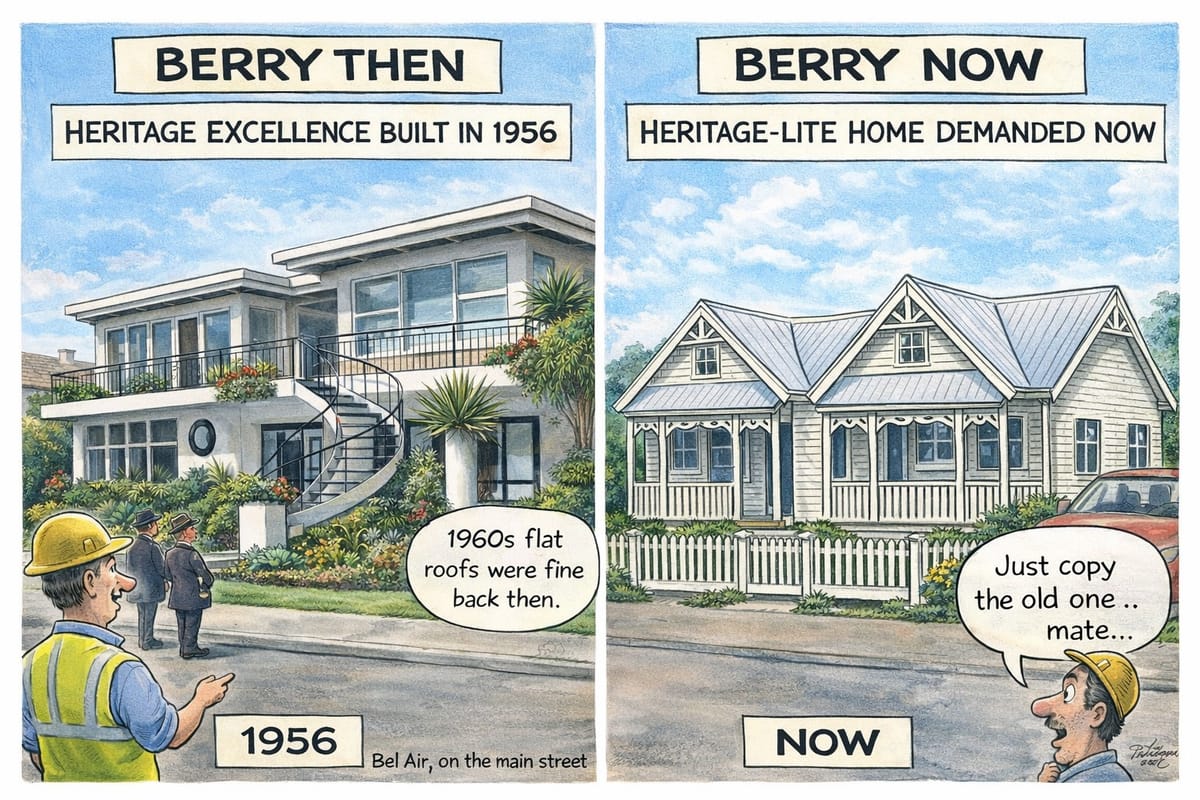
Back in 1956, a flat-roofed modernist Bel Air home was approved on Queen Street. Decried at the time as an eyesore, today it is one of the most prized heritage-listed homes in the area. Under the new aesthetic logic embedded in this DCP, such a home would be fiercely resisted. That is the mad paradox of all this.
Heritage protects what is significant. Character, when tightened like an aesthetic straitjacket, will mandate the replication of 1940s–50s weatherboard cottages across non-heritage sites, stifling today the expression of tomorrow's heritage.
You can be for heritage. You can be for thoughtful design. You can be for young people staying in town. You can be for housing supply. You can be for financial prudence. And you can still embrace contemporary architecture that becomes tomorrow’s heritage.
What you cannot be (if good governance matters) is inconsistent about where and how you apply key principles.
Because when ideas of “character” replace or become interchangeable with heritage protections, and definitions change meaning from town to town, when systemic reform is blocked but hyper-local control is embraced, when political optics override statutory alignment, what is being protected is not what we value the most today and what is being supported is not what we need tomorrow.
Berry may well look the same in ten years, but the families and businesses of Berry will now face the consequences of the lack of distinction between heritage and character.
 The Illustrated Burra Charter
Kate Dezarnaulds is Co-Chair of Flexible Workspace Australia and formerly President of the Berry Chamber of Commerce and Tourism. In 2025, she was a Community Independent candidate for Gilmore and the Kiama State By-Election.