Careful What You Wish For
In this edition:
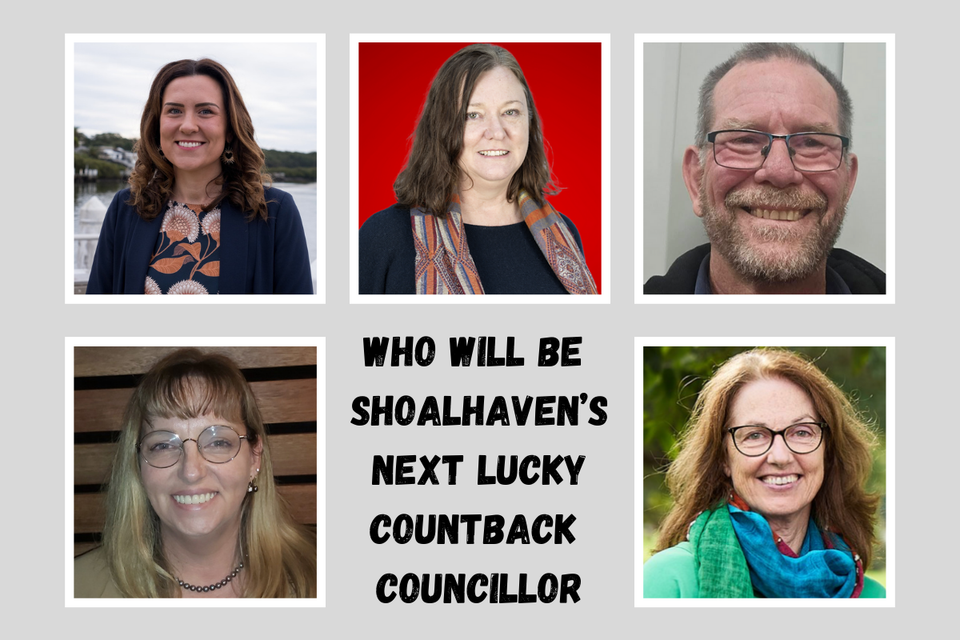
Citing legal risks and Safework standards, Shoalhaven Council voted to eliminate Community Consultative Bodies by July 1, 2026. But what will replace them is unclear.
Common ground between Shoalhaven and Kiama Councils is increasing. But that's not necessarily building trust and confidence among ratepayers.
Ex-Kiama Councillor, Karen Renkema-Lang recounts an invigorating evening at Melbourne's Centre for Public Integrity, exploring "restoring integrity to the foundations of Australia’s democracy".
Last night, Shoalhaven Council voted 6-5 to get rid of Community Consultative Bodies (CCBs) without anybody first doing actual community consultation.
Oh, the irony!
Change is definitely needed. But stakeholder discussion is imperative.
by Cat Holloway
Clearly there are a few CCBs that function poorly, or not at all. The Berry Forum, a large and politically influential CCB (some of whose committee were also hand-picked by Mayor Patricia White to sit on her election-promised Financial Review Panel) has recently become engulfed in a nasty and now litigious war with ratepaying constituents.
That acrimony provided the perfect excuse for the Mayor and CEO to pull the plug on everyone else, throwing the proverbial baby out with the bathwater.
As an extension of Council, CCBs that behave badly put Council at risk - legally, reputationally and functionally unable to live up to its own standards mandated by the Local Government Act.
But many CCB executives are asking: Why rush this through just before Christmas, without CCB committees, or even the councillors, being given any time to taste-test the idea, let alone digest its implications?
It's not like the unspecified legal/insurance threats, SafeWork "orders" or specific cases of poor representation will change over the coming holidays.
Those six weeks would have been an ideal time for the many experienced volunteers across the Shoalhaven to ruminate on constructive reforms and repairs to rejuvenate their CCB landscape.
Instead, as CCB volunteers serve up a Christmas lunch for isolated locals, arrange Santa drop-ins for excited children, load the doggie-poop bag dispensers with extra rolls for the influx of tourists or bust their butts organising sausage sizzles and entertainment at Australia Day community breakfasts, they'll be warning their friends and neighbours that these events might be their last.
How festive.
And how deeply disrespectful to most of the committees who have worked diligently for their hometowns for decades.
According to one of several letters sent to Councillors opposing this loosely formed motion that narrowly passed, the “Next Steps” are vague and involve "serious risk to community democracy".
But Berry entrepreneur, Peter Yannopoulos, recently took action against the Berry Forum CCB and rallied other community members to speak out, after the organisation shut him out of participation and communication following disagreement over Yannopoulos's restaurant expansion.
Yannopoulos wrote on Facebook's Eye on Shoalhaven Council group yesterday, and in a mesage to his supporters last night, that he did not intend for his dissent or defamation concern to trigger a decision to shut down all Shoalhaven CCBs by July.
"If there are problematic CCBs, then deal with them directly. Reprimand them, reform them, or shut them down individually if necessary, but don’t make every other committee suffer as a result," Yannopoulus wrote.
But after the CEO Andrew Constance's call to dissolve CCBs succeeded, Yannopoulos chose optimism and urged his supporters to actively participate in the promised consultation process to start in February.
"Speaking up is what got us here and, if done constructively, it’s also what will ensure these community groups are set up properly and can communicate effectively with Council going forward," Yannopoulus wrote
"I will now focus my efforts on ensuring the consultation for the new community bodies is genuinely inclusive, designed to capture feedback from all walks of life, not dominated by any single voice or agenda."
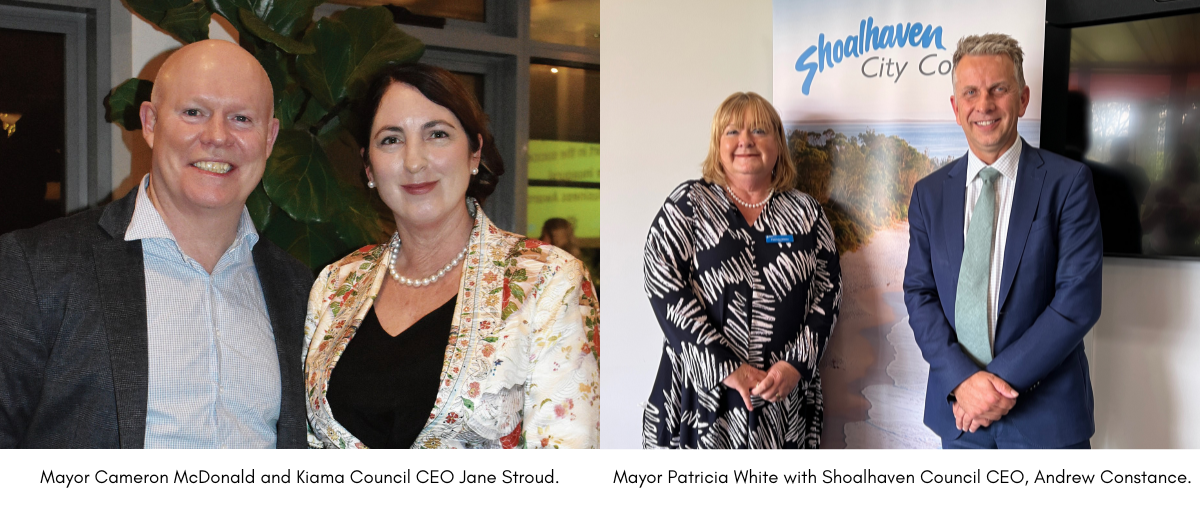
One possible source of inspiration for Shoalhaven CEO Andrew Constance's zealous reaction rather than considered strategy might be advice from close colleagues in Kiama Council.
Kiama, a much smaller geographical LGA, happened to go through this precise process a couple of years ago under CEO Jane Stroud, but community members in Kiama have serious criticisms of their Council's approach to community consultation.
"Now, there is no place for people to voice their concerns face-to-face, which I think is detrimental to social cohesion generally. But, I'm sure the majority of Council is happy to not get feedback from Precinct groups, because they've reduced community consultation across the board anyway." wrote one Kiama commenter.
Throughout the CCB debate online and in Shoalhaven Council last night, stakeholders agreed with Council that review and reform was welcome.
But, yet again, the Mayor (and her CEO partner) have enthusiastically endorsed leapfrogging an equitable and practical process of talking it over first with the stakeholders who are actually doing the work.
That discussion must happen before July 1, inevitably in a truncated and hasty way given the huge geographical area and large number of community groups who will want to have their say.
It would have been polite to ask first and allow time for some initial feedback. It would have been democratic.
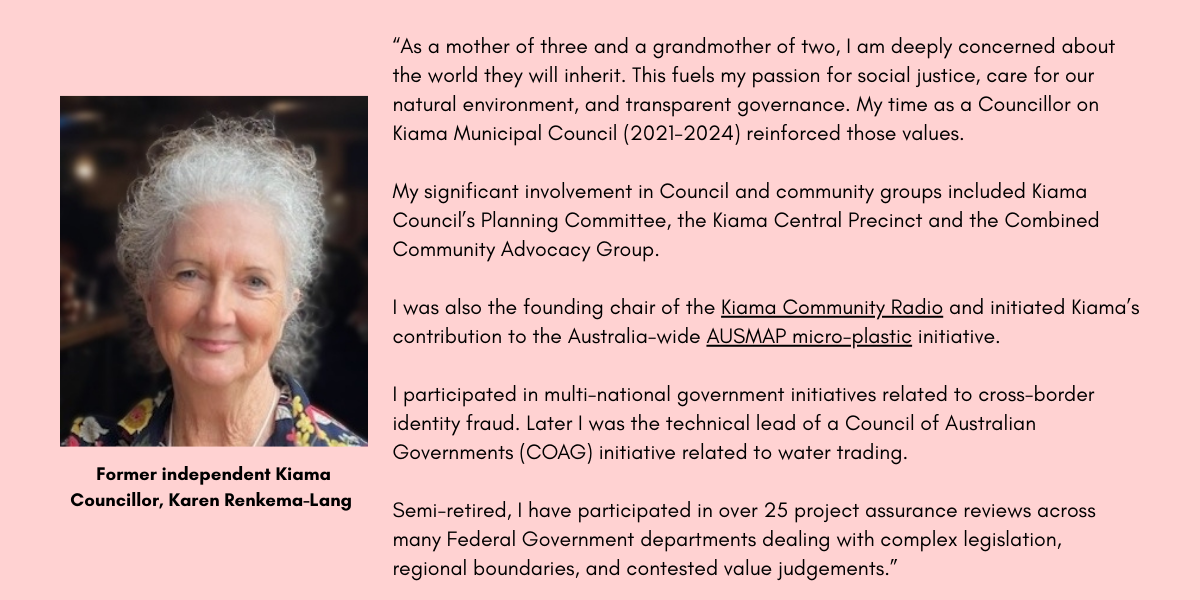
Which leads me to today's special contributor, Karen Renkema-Lang who recently spent an invigorating evening at Melbourne's Centre for Public Integrity, an independent research institute dedicated to fighting corruption and "restoring integrity to the foundations of Australia’s democracy".
Every now and then life throws flashes of hope your way. My evening with the Centre for Public Integrity in Melbourne last week was one such occasion.
by Karen Renkema-Lang
It is becoming increasingly important across all levels of government, and it goes straight to issues communities in places like Kiama and Shoalhaven have been grappling with — financial mismanagement, closed-door decision-making, weak accountability, jobs for mates, and the heavy personal cost borne by those who speak up.
The Centre for Public Integrity has been focusing on a simple but crucial question - who is watching the decision-makers, and what happens when things go wrong?
Transparency isn’t a “nice to have”
One of the Centre for Public Integrity’s biggest concerns has been the federal government’s proposed changes to Freedom of Information (FOI) laws, which would make it harder for the public, journalists and community groups to access government documents.
For local communities, this really matters. Many of the problems uncovered at council level — from long-running operating deficits and failed projects, to questionable land deals or planning decisions — only come to light because someone asks hard questions or digs into documents.
The Centre for Public Integrity has warned that when governments make it harder to access information, poor decisions stay hidden for longer, and communities pay.
But financial mismanagement doesn’t happen in a vacuum
The Centre for Public Integrity’s work on integrity regularly highlights a recognisable local pattern:
- problems build up over years
- oversight is weak or ignored
- warnings are downplayed,
- by the time intervention happens, the damage is already done.
This pattern is familiar in Kiama, where audited financial misstatements, year-on-year operating deficits and the Blue Haven Bonaira disaster eventually triggered a NSW Government Performance Improvement Order.
It’s also familiar in Shoalhaven, where past land sales and major development decisions — including the long-running Buddhist temple / Comberton Grange saga — continue to cast a long shadow over trust in Council decision-making.
The Centre for Public Integrity’s message is clear - integrity systems are meant to prevent these failures, not just clean up afterwards.
Hey Shoalhaven, does this sound familiar?
Letter to the Editor, Kiama Bugle, by Karen Renkema-Lang
The work of the Centre for Public Integrity is becoming increasingly important across all levels of government, and it goes straight to issues Kiama Council has been grappling with for several years.
In Kiama, residents have lived through years of financial stress, closed-door decision-making and state intervention — with real costs to the community.
Since 2023, Kiama Council has settled major property sales totalling approximately $129 million or more in gross proceeds. While asset sales may have been necessary to rebuild financial stability, they represent a once-off loss of community assets.
Council’s own financial statements also show that legal expenses have escalated dramatically. After sitting in the hundreds of thousands earlier in the decade, legal costs jumped into the millions (approximately $3.3 million in 2023–24, and approximately $2.275 million in 2024–25). These are now material operating expenses for a small council — reflecting the financial impact of prolonged litigation, governance disputes and regulatory intervention.
During this same period, while Council was recording ongoing operating deficits, under an extended Performance Improvement Order, and actively selling major assets to stabilise its balance sheet, the CEO’s total remuneration increased significantly. Annual Reports detail an increase from around $350,000 in 2021–22 to an estimated $428,000 in 2024–25 — an increase of well over 20%.
At the same time, Council’s operational responsibilities were reduced substantially, with staffing numbers dropping by an estimated 30% once aged-care operations exited the organisation.
For many in the community, the contrast between rising executive remuneration during a period of contraction, deficit and state oversight goes to the heart of integrity and trust. It also raises legitimate questions about why Kiama Council still recorded an operating deficit of more than $7 million in the last financial year (2024–25).
The Centre for Public Integrity consistently warns that when transparency is weak and scrutiny is silenced, problems don’t disappear — they compound. Kiama’s experience reflects this pattern
Integrity isn’t about blaming individuals. It’s about rebuilding trust and demonstrating that openness, accountability, fairness — and protection for those acting in the public interest — are once again at the centre of how the Council operates.
Accountability means consequences — not just process
Another theme in the Centre for Public Integrity’s work is that accountability often stops at “process”. Reports are written, reviews are conducted, and lessons are promised — but responsibility is rarely clear.
This resonates locally, where communities have watched
- serious financial and governance failures unfold
- Councils placed under state supervision
- dubious CEO appointments, and
- yet very few individuals or systems meaningfully held to account
The Centre for Public Integrity argues that accountability only works when there is real scrutiny, independent oversight, and consequences when standards are breached.
“Jobs for mates” and public trust
The recent appointment of a Andrew Constance – a person who has no work experience as a Chief Executive nor in local government administration – as Shoalhaven City Council's CEO has further eroded trust.
In a widely read opinion piece, Anthony Whealy KC, Chair of the Centre for Public Integrity, warned that senior public appointments which appear political, rushed, or insufficiently transparent risk reinforcing a damaging “jobs for mates” culture — even if no rules are technically broken.
The point is not about individuals, but about process and perception. When senior roles are filled without clear, open and demonstrably merit-based processes, public confidence takes a hit. Once trust is lost, it is extremely difficult to rebuild.
For a council like Shoalhaven with a history of controversy and community scepticism, appointments must meet the highest possible transparency standards, not just the minimum legal ones.
The cost of speaking up. Why whistleblower protections matter
Perhaps the most important local connection to the Centre for Public Integrity’s work is its strong advocacy for whistleblower protections.
Across Australia — including at local government level — people who raise concerns often face retaliation or isolation, legal threats, career damage, or being labelled “troublemakers”.
The Centre for Public Integrity has consistently warned that without strong, independent whistleblower protections, corruption and maladministration flourish — not because everyone is dishonest, but because people learn it’s safer to stay quiet.
This has particular resonance in councils like Kiama, where whistleblowing, public criticism, or speaking to the media has sometimes been met with censure attempts, referrals, or legal escalation rather than open engagement with the substance of concerns.
The Centre for Public Integrity has supported reforms to ensure whistleblowers can report concerns safely and independently while being protected from retaliation and not punished for acting in the public interest
Their position is blunt - if integrity relies on courage alone, it will fail.
Better examples exist — and they matter
The Centre also points out that things can be done differently.
In South Australia, the government has worked openly with integrity bodies and civil society on lobbying reform and political donation bans.
That kind of openness stands in stark contrast to cultures — local or national — where scrutiny is treated as an inconvenience and transparency as a threat.
Why this matters to our community
For local communities, this isn’t theoretical. Weak integrity systems lead to
- ratepayers carrying the cost of bad decisions
- years of community division and distrust
- burnout among volunteers and civic leaders, and
- a sense that ordinary people don’t have a voice
The Centre for Public Integrity’s work reinforces something many locals already know, strong integrity protections aren’t about politics — they’re about fairness, trust and good governance.
When transparency is real, whistleblowers are protected, and accountability is enforced, communities are stronger — and fewer people are left carrying the burden of speaking truth to power alone.